


Bangladesh's readymade garment (RMG) industry has the potential to generate 1,768-megawatt-peak (MWp) of electricity from rooftop solar with an estimated investment of US$188.2 million, according to a study by the Centre for Policy Dialogue (CPD).
Some 509 factories are already investment-ready and can use their available rooftop space for solar installations without additional support, enabling them to meet part of their electricity needs amid persistent energy shortages.
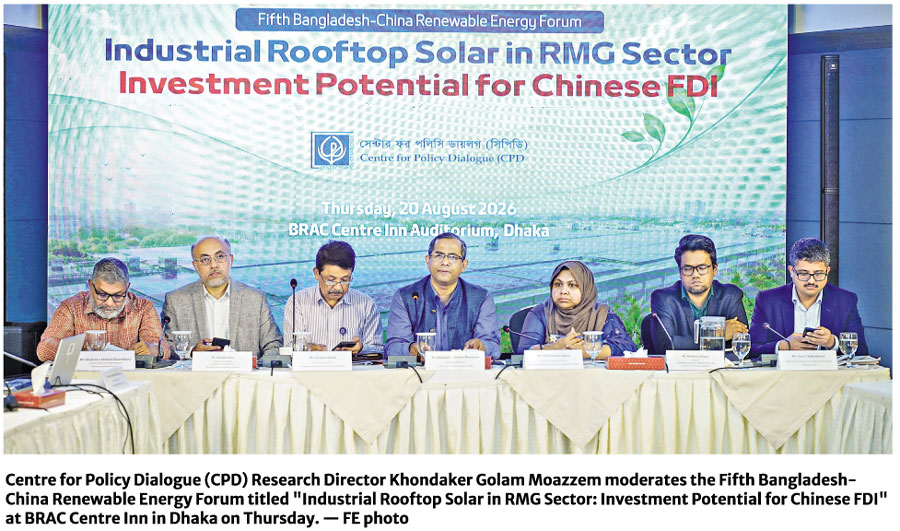
CPD Research Associate Abrar Ahmed Bhuiyan shared the study findings at the Fifth Bangladesh-China Renewable Energy Forum, titled "Industrial Rooftop Solar in RMG Sector: Investment Potential for Chinese FDI", at Brac Centre Inn in the city on Thursday.
CPD Research Director Khondaker Golam Moazzem moderated the event.
Using high-resolution satellite imagery from the Google Open Buildings dataset, cross-referenced with national manufacturing census records, the CPD mapped 9.73 million square metres of usable industrial rooftop space across 3,320 factories.
It estimated a total technical rooftop solar potential of 1,768.3 MWp across 2,303 factories, including 61 large, 320 medium and 1,922 small units out of the 3,320 factories.
Large factories can meet 39.9 per cent of their electricity demand through rooftop solar, while the corresponding figures for medium and small factories are 33.1 per cent and 38 per cent, respectively.
The study also found that, of the 2,303 units, 1,359 factories are investable with support such as credit enhancement, interest-rate subsidies or extended loan tenors, while the remaining 427 factories require intervention due to roof-structure limitations, low confidence matching or weak debt-servicing capability.
The study revealed that project bankability is highly sensitive to commercial interest rates.
High commercial interest rates ranging between 9.0 per cent and 12 per cent, along with strict collateral requirements, put SMEs at a disadvantage compared with large conglomerates, despite SMEs accounting for about 55 per cent of industrial power consumption.
The CPD recommended establishing dedicated blended-finance windows combining IDCOL concessional debt at 5-7 per cent with Chinese green FDI capital, fast-tracking SREDA certification processes, and creating BGMEA/BKMEA rooftop aggregation hubs in high-density industrial clusters such as Gazipur and Narayanganj.
Speaking at the event, Bangladesh Knitwear Manufacturers and Exporters Association (BKMEA) Director Minhajul Hoque outlined three key recommendations to help the garment industry navigate the current energy crisis.
He called for an official government directive prohibiting utility distributors such as Titas, REB and DESCO from disconnecting gas or electricity lines of factories with a reliable six-to-12-month bill-paying record if they experience short-term payment delays during the ongoing crisis.
He further called for establishing a structured, zone-wise gas-rationing plan with clearly defined timelines and guaranteed pressure levels, such as 12 to 14 hours of supply per day at specified PSI levels, so factories can predictably manage production shifts and avoid operational losses.
The BKMEA leader also urged the government to provide gas-tariff adjustments or subsidies using additional revenues collected from recent gas price hikes, allowing factories to use the funds directly to install rooftop solar capacity within a year without relying on bank loans.
Shah Nusrat Jahan, Director (Deputy Secretary) at the Bangladesh Investment Development Authority (BIDA), said BIDA had developed an investment heatmap covering 19 priority sectors, with renewable energy ranked as the top focus for both foreign direct investment (FDI) and local investment.
Terming China the top source of FDI, she said BIDA operates a dedicated China Desk alongside sector-specific teams, with multiple Chinese renewable-energy investment proposals currently in the pipeline following recent high-level delegation visits.
Speakers stressed the need for Chinese investment, saying there is little or no investment from China in industrial rooftop solar installations.
Swapan Banik, Chief Engineer (P&O) at the Bangladesh Rural Electrification Board (BREB), and Tanul Chakraborty, Head of Power, Energy and Environmental Sustainability at Ha-Meem Group, among others, also spoke at the event.
