


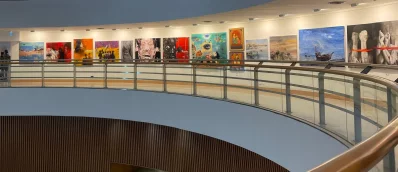
To honour the 54th anniversary of Bangladesh’s independence, Galleri Kaya has inaugurated a major group art exhibition titled Glimpses at the Bangkok Art and Culture Centre (BACC), one of Thailand’s premier contemporary art venues.
The exhibition opened on December 2 and will continue until December 14, showcasing works from thirteen eminent Bangladeshi artists spanning multiple generations and disciplines.
Yuthika Isarangkura, the deputy permanent secretary for culture at the Ministry of Culture of Thailand, attended the inaugural session as the chief guest.
Additionally, the Ambassador of Bangladesh to Thailand, Faiyaz Murshid Kazi, along with Goutam Chakraborty, the director of Galleri Kaya, were also present as guests at the event.
Organisers describe Glimpses as a cultural bridge that celebrates Bangladesh’s artistic evolution while strengthening Bangladesh–Thailand creative collaboration.
The exhibition is part of a broader program marking the independence anniversary abroad, featuring lectures, artist interactions, and gallery walk-throughs at BACC.
The participating artists include Hamiduzzaman Khan, Abdus Shakoor Shah, Chandra Shekhar Dey, Ranjit Das, Jamal Ahmed, Ivy Zaman, Sheikh Afzal Hossain, Kanak Chanpa Chakma, Mohammad Iqbal, Shambhu Acharya, Maksuda Iqbal Nipa, and Ashraful Hasan.
Their works span modern sculpture, folk ballad-inspired compositions, contemporary figurative painting, neo-expressionism, scroll painting, and abstract explorations of colour and texture — offering international audiences a rare, panoramic view of Bangladesh’s visual arts.
Abdus Shakoor Shah
Abdus Shakoor Shah is widely acknowledged for his folk motifs and ballads. Throughout a significant portion of his career, Shakoor has dedicated himself to the exploration of folk motifs and ancient ballads. The folk ballads of Mymensingh, including the renowned Mahua and Malua love stories, Nakshi Kanthar Maath, Gazir Pata, and Manasha Pata, have secured prominent positions in his artistic creations. In his artwork, peacocks and parrots are prominently featured. Shakoor also incorporates various animals such as elephants, bulls, dogs, cats, tigers, birds, serpents, and reptiles, all serving as delightful and decorative motifs.
Ashraful Hasan
Ashraful Hasan is an artist whose paintings encourage us to contemplate innovative and refreshing ideas. His creations, which utilise acrylic, charcoal, and pastel mediums, exhibit exceptional detail through striking illustrations, showcasing his profound ability to articulate and compose semi-figurative representations. He has applied his finely honed understanding of craftsmanship and skill to depict images that frequently address themes of deforestation and the inhumane aspects of humanity. He prefers to delve into the intricacies of his subjects, selecting to construct his narrative by focusing primarily on the significant details present on the surfaces of the depicted objects.
Chandra Shekhar Dey
Chandra Shekhar Dey demonstrates remarkable artistic versatility through his ability to adapt to various forms of expression throughout his career. He proficiently shifts between different styles on his canvas, highlighting his skill in maintaining multiple modes of expression simultaneously. Throughout the various phases of his career, he has explored realistic, semi-realistic, surrealistic, folk, abstract impressionism, symbolism, figurative, neo-expressionism, and more. His meticulous attention to detail is apparent in the careful arrangement of figures within his work. Each piece results from his deliberate brush strokes and gentle textures, producing a magnificent appearance on canvas or paper.
Hamiduzzaman Khan
Hamiduzzaman Khan was a dedicated sculptor who forged a uniquely individual path in the realm of art, characterised by significant forms, themes, and variations in his work. The majority of his sculptures are either stylised figurative representations (encompassing both male and female shapes) or abstract forms, crafted from materials such as painted steel, concrete, granite, plaster of Paris, iron, bronze, white granite, black marble, Carrara marble, pink granite, a blend of green and white marble, cement, and various other metals.
Jamal Ahmed
Jamal Ahmed gained recognition in the 1980s. Following his graduation from the Institute of Fine Arts, which is now known as the Faculty of Fine Arts at the University of Dhaka, he furthered his education in Poland and Japan. These educational experiences enabled him to delve deeply into his subject and discover new aspects of the topic. Throughout the years, Jamal has adeptly captured the picturesque beauty of Bengal, including the alluring forms of young women, gypsy women, oarsmen, boatmen, people affected by floods, peaceful landscapes, riverine communities, urban life, bauls, mendicants, and the working class, among others. His artwork frequently features pigeons, horses, fishermen, marginalised people, and their everyday activities.
Kanak Chanpa Chakma
Kanak Chanpa Chakma has dedicated a considerable amount of time to exploring ethnic themes. Her artwork consistently showcases indigenous people engaged in their daily activities. The use of rich texture and a soft surface, combined with careful spatial arrangements, gives her pieces a distinctive signature. She draws inspiration from the vibrant colours of traditional attire, the hills, forests, jhum cultivation, crystal-clear waterfalls, as well as the dance and music that characterise life in the hilly regions of Bangladesh. Additionally, her works reflect the tranquil moods associated with Buddhism and its diverse spiritual dimensions. In her art, semi-realistic and abstract elements intertwine. The figures portrayed in her paintings are animated and effectively engage with viewers through their expressive qualities.
Maksuda Iqbal Nipa
Vibrant colours, flexible brushwork, and striking imagery are prominent characteristics in the remarkable artworks of Maksuda Iqbal Nipa, a talented artist who has been working diligently to carve out a unique niche for herself in Dhaka's art community.
Nipa, an introspective and imaginative painter, draws her colours from nature, making colour the most crucial element in her artworks. She enjoys experimenting with colour in all its diverse forms. Nipa applies colour directly, layering it thickly on the canvas. These layers impart a unique quality to her work, which is why her canvases bear a distinct signature. Her focus has been on the application of colours. The deep layers of colour contribute a one-of-a-kind texture to her canvas, establishing a singular hallmark.
Mohammad Iqbal
From the outset of his career, Mohammad Iqbal's creative process has been spontaneous, evocative, meticulous, and intricate. It is important to note that the artist initially focuses on his theme before dedicating his efforts to other technical elements. Throughout his professional journey, the painter remains highly conscious of his foundational influences and their philosophical and intellectual dimensions. In the past, the painter prioritised his subject over its technical execution. During that period, he employed impasto techniques, where materials blend with one another. In addition to engaging with the subject matter, he was involved with rich colours, crafting the character using a skillfully wielded spatula and brush on his canvas.
Ranjit Das
Ranjit Das’ artistic approach evolved progressively following his acquisition of a Master's degree from MS University, Baroda, India, in 1981. He was a direct student of the renowned artist KG Subramanian. His canvases explore the struggles and joys of ordinary people. His creations distinctly reflect the aspirations and dreams of the masses. Over time, Ranjit has developed into a dedicated artist.
Recently, Ranjit’s figurative artworks exhibit a blend of realism with a slightly distorted appearance. He is currently crafting figures, faces, and various components of forms. Several animals, including dogs, horses, crows, swans, and peacocks, have appeared on his canvases, alongside figures and other varied forms.
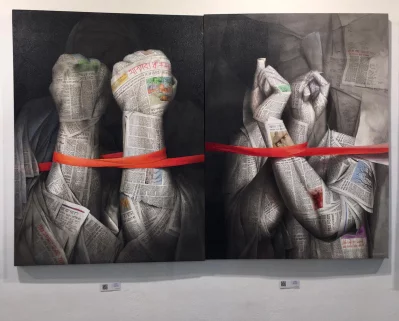
Shambhu Acharya
Shambhu Acharya, a renowned Pata Chitra artist, has garnered significant appreciation from art enthusiasts and collectors in the country. His family has been engaged in the practice of Pata Chitra, or scroll painting, for over 450 years, encompassing nine generations. The subjects depicted in the paintings include Gazir Pata, Sree Krishna, Muharram, Ramayana, Mahabharata, Manusha Mangal, Rass Leela, and various other themes derived from local folk culture. Although the original cultural landscape and rural economy that once supported patas have diminished, Shambhu has embraced the duty of advancing this ancient art form and safeguarding it for future generations. He bears the responsibility of perpetuating the family tradition of ‘Pata Chitra.’
Sheikh Afzal Hossain
From the outset of his career, Sheikh Afzal has adeptly captured the lives of underprivileged communities and their daily activities, the scenic beauty of rural landscapes, as well as the graceful forms of young women. His artwork features fishermen, rural women, oarsmen, boatmen, flood-affected communities, idyllic views, riverine inhabitants, peasants, and the working class, among others. Recurring themes in his paintings include cowboys, disadvantaged folks and their daily routines, herds of cows and buffalo, day labourers, goats, and people enjoying leisure time in conversation. The subject matter also encompasses striking representations of the female figure and individuals of all ages and circumstances, including children, the child-mother bond, and elderly men and women from lower socio-economic backgrounds. Many of Afzal's paintings illustrate joyful family life. The figures are exquisitely rendered, and their facial expressions convey a cheerful atmosphere.
Ivy Zaman
Ivy Zaman is a sculptor who earned her BFA in Sculpture from the Bangladesh College of Arts and Crafts (currently known as the Faculty of Fine Arts, University of Dhaka) in 1980. Subsequently, she traveled to Visva-Bharati, Santiniketan, India, where she spent three years furthering her education in Sculpture. Her sculptures embody the indomitable spirit of an artist who, for over thirty-five years, has diligently worked across various artistic mediums to achieve her own summit as a tireless sculptor. She has chosen not to limit herself to a comfortable niche, instead bravely exploring multiple avenues that have, rather than destabilizing her, enhanced her skills as an artist.
Galleri Kaya has previously organised exhibitions in Kathmandu, Kolkata, Mumbai and Seoul. Glimpses marks its second major initiative in Thailand, reinforcing an ongoing cultural exchange between the two nations.
With nearly two weeks of viewing, workshops, and curator interactions, Glimpses is expected to draw thousands of visitors at BACC — offering Bangkok audiences a vibrant window into Bangladesh’s contemporary art movement.
The writer is an art critic and cultural curator.
